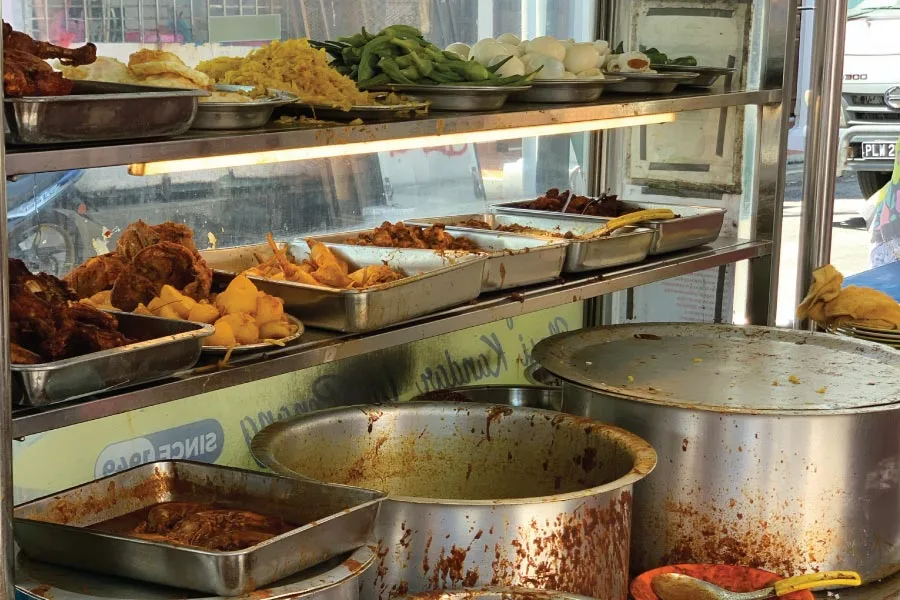
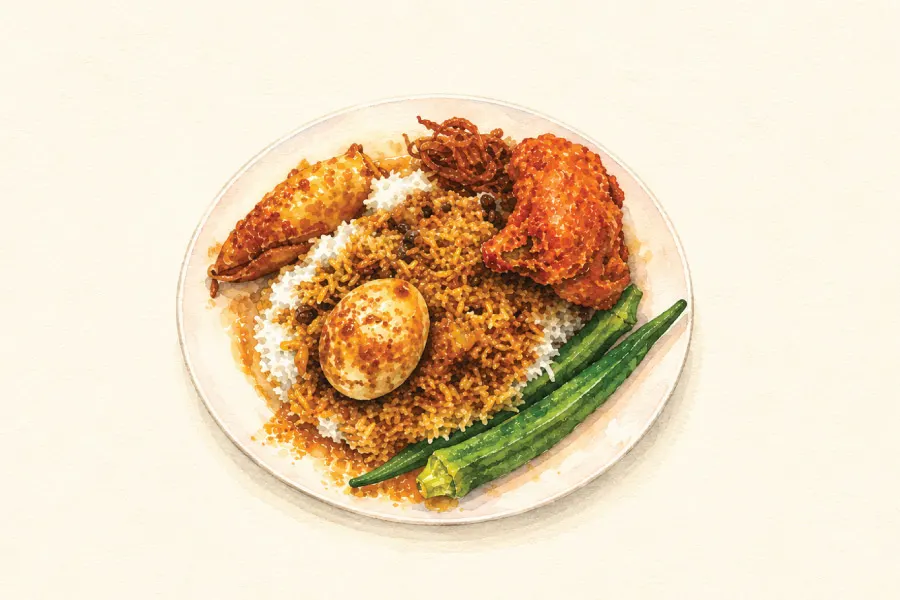
Walk into a Nasi Kandar restaurant in Malaysia and you will usually be greeted by a tempting display: fried chicken, beef, squid, fish, prawns, vegetables and curries lined up behind a counter, ready to be spooned onto a plate of rice.
Then comes one of the most important parts — the gravy.
A little fish curry, perhaps some chicken curry, a touch of something darker and richer, all poured over the same plate of rice. What looks like a simple plate of rice and curry becomes an intensely flavourful combination unique to Nasi Kandar.
Originating in Penang and closely associated with the Indian Muslim community, Nasi Kandar has grown from humble street food into one of Malaysia’s most recognisable meals.
But what exactly is Nasi Kandar, why is it called “kandar”, and what should you order if you are trying it for the first time?
Quick Answer: What Is Nasi Kandar?
Nasi Kandar is a Malaysian rice meal originating from Penang, traditionally associated with Indian Muslim food vendors. Rice is served with a selection of curries, meat, seafood, vegetables and mixed curry gravies.
Customers generally choose their dishes from a counter before different curry sauces are spooned over the rice.
While fried chicken is one of today’s most popular choices, there is no single combination that defines Nasi Kandar. Part of the experience is creating your own plate.
What Does Nasi Kandar Mean?
The name tells part of the story behind the dish.
Nasi means rice in Malay.
Kandar refers to the traditional method of carrying goods using a pole balanced across the shoulder, with baskets or containers hanging from either end.
Early Nasi Kandar vendors in Penang are associated with this method of carrying rice and curries around to sell to customers.
The carrying pole disappeared as hawkers moved into permanent stalls and restaurants, but the name remained.
Where Did Nasi Kandar Originate?
Nasi Kandar is most strongly associated with Penang, particularly George Town.
Its history is closely connected to the Indian Muslim community and the development of Penang as a busy trading port.
Early vendors sold inexpensive rice and curry meals to workers around the port and commercial areas. The food was filling, flavourful and practical for people looking for a substantial meal.
Over generations, what began as relatively simple food sold by mobile vendors developed into a distinctive restaurant culture.
Today, Nasi Kandar restaurants can be found throughout Malaysia, but Penang remains particularly famous for the dish.
What Is In Nasi Kandar?
Unlike Nasi Lemak, Nasi Kandar does not have one fixed set of accompaniments.
Think of it instead as a combination of several components.
Rice
Rice forms the base of the meal.
Depending on the restaurant, this may be plain steamed rice or rice prepared with subtle aromatics and flavouring.
The rice has an important job: absorbing the different curries poured over it.
Curry Gravies
Curry is arguably the defining element of Nasi Kandar.
Restaurants typically prepare several different gravies, which may accompany chicken, fish, beef, mutton or seafood dishes.
Instead of choosing only one, customers often have several gravies mixed together over their rice.
The resulting combination can be spicy, savoury, aromatic, tangy and slightly sweet at the same time.
Meat and Seafood
Nasi Kandar restaurants are known for their large selection of dishes.
Common choices include:
- Fried chicken
- Curry chicken
- Beef
- Mutton
- Fish
- Squid
- Prawns
- Fish roe
Some restaurants become particularly famous for one signature dish.
Vegetables
Vegetable dishes provide some balance against the richer curries and proteins.
Cabbage, okra, bean sprouts, bitter gourd and other vegetables are commonly available depending on the restaurant.
Side Dishes
Other accompaniments may include boiled eggs, salted eggs, papadom and various pickles.
The exact selection varies considerably between Nasi Kandar restaurants.
What Is “Kuah Campur” in Nasi Kandar?
One of the most distinctive aspects of eating Nasi Kandar is kuah campur, meaning mixed gravy.
Instead of spooning only one curry onto the rice, the server combines several different curry gravies.
For example, your plate might receive some fish curry, chicken curry and another darker gravy.
Each contributes something different.
One may provide heat, another richness, another acidity and another aromatic spices.
Experienced servers often know how much of each gravy to add to create a balanced combination.
For many Nasi Kandar enthusiasts, the mixed gravy is just as important as the chicken, beef or seafood sitting beside it.
What Does “Kuah Banjir” Mean?
You may also hear Malaysians ordering their Nasi Kandar banjir.
The Malay word banjir literally means “flood”.
In the context of Nasi Kandar, it means generously covering or “flooding” the rice with curry gravy.
If you enjoy plenty of curry soaking into your rice, you can ask for more gravy or kuah banjir.
However, kuah campur and kuah banjir do not mean exactly the same thing.
Kuah campur refers to mixing different gravies, while kuah banjir refers to serving the rice with a generous quantity of gravy.
You can therefore have both: several curries mixed together and plenty of them.
What Does Nasi Kandar Taste Like?
There is no single flavour that describes every plate of Nasi Kandar because every combination can be different.
Generally, expect bold and intensely savoury flavours.
The curries may introduce:
- Chilli heat
- Warm spices
- Richness
- Tanginess
- Saltiness
- Subtle sweetness
A fried chicken adds crispness and spice, while squid curry can bring sweetness and a seafood character. Vegetables provide contrast, and the rice absorbs everything underneath.
Perhaps the defining characteristic of Nasi Kandar is therefore not one particular flavour, but the layering of several flavours on a single plate.
Popular Nasi Kandar Dishes to Try
Faced with a counter containing dozens of dishes, first-time visitors may not know where to begin.
Here are some common choices.
Ayam Goreng
Fried chicken is one of the easiest introductions to Nasi Kandar.
Depending on the restaurant, the chicken may be marinated with spices before being fried until deeply browned and aromatic.
Ayam Bawang
Chicken served with plenty of cooked onions is another popular option at some Nasi Kandar restaurants.
The onions introduce sweetness that works particularly well with spicy curry gravies.
Ayam Ros
Ayam Ros is a rich chicken preparation found at many Nasi Kandar establishments, although recipes vary between restaurants.
It is generally characterised by a reddish, richly seasoned gravy and is a popular alternative to fried chicken.
Daging
Beef dishes are another staple, ranging from curry preparations to darker and richer gravies.
Kambing
Mutton pairs naturally with the assertive spices used in Indian Muslim cooking and is a popular choice for diners wanting something richer.
Sotong
Large squid covered in curry is one of the most visually recognisable dishes at many Nasi Kandar restaurants.
It can also be considerably more expensive than basic chicken dishes, particularly when ordering a whole squid.
Udang
Large prawns are another premium option commonly displayed at the counter.
Telur Ikan
Fish roe is a favourite among some Nasi Kandar enthusiasts and offers a distinctive texture that differs from the more familiar chicken and meat dishes.
Bendi
Okra — commonly called bendi in Malay — is an excellent vegetable accompaniment because it works particularly well with curry.
How to Order Nasi Kandar
Ordering Nasi Kandar is straightforward once you understand how the system works.
Start with rice, then point to the meat, seafood and vegetables you would like.
After choosing your dishes, tell the server how you want your gravy.
You can ask for one particular curry, but trying kuah campur is a good introduction to the traditional Nasi Kandar experience.
A simple first order could be:
Rice + fried chicken + vegetable + kuah campur.
Once you understand the flavours, you can start experimenting with different combinations.
How Much Does Nasi Kandar Cost?
There is no fixed price for a plate of Nasi Kandar because the total depends on what you order.
A relatively simple plate with rice, chicken and vegetables can be affordable, while adding large prawns, squid, fish or several premium dishes can increase the price substantially.
This is particularly worth knowing if you are visiting Malaysia for the first time.
When choosing seafood, you can ask the server for the price before ordering if it is not clearly displayed.
Nasi Kandar vs Nasi Campur: What’s the Difference?
At first glance, Nasi Kandar and Nasi Campur can look very similar.
Both involve rice accompanied by your choice of prepared dishes.
The difference lies primarily in their culinary traditions.
Nasi Kandar developed from the Indian Muslim food tradition and is particularly characterised by its assortment of curries and the practice of mixing different curry gravies over rice.
Nasi Campur, meaning “mixed rice”, is a broader term for rice served with a selection of dishes. Different versions exist across Malay, Indonesian and other regional cuisines.
Not every plate of rice with several curries is therefore Nasi Kandar.
Nasi Kandar vs Nasi Lemak
Nasi Kandar and Nasi Lemak are both famous Malaysian rice dishes, but they are fundamentally different.
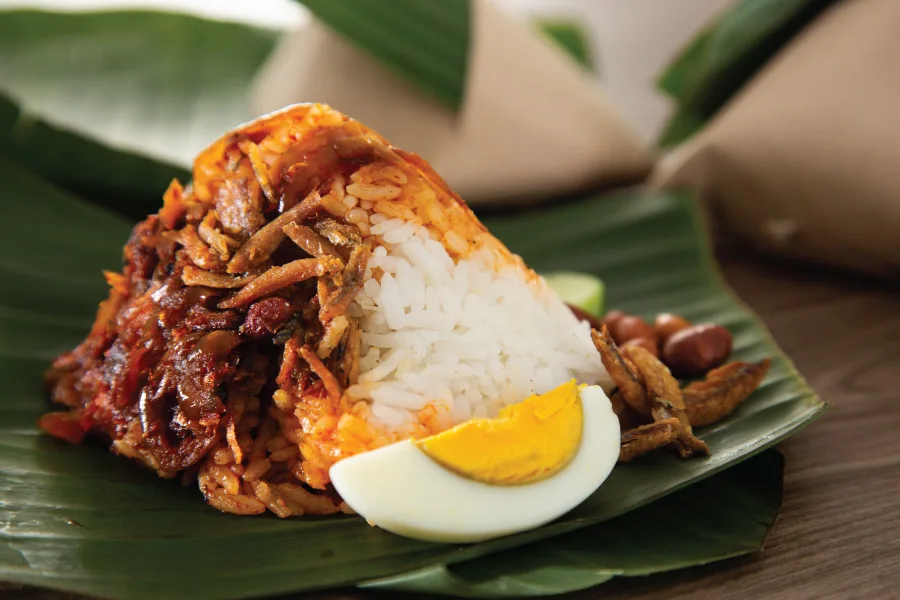
Nasi Lemak is built around fragrant rice cooked with coconut milk and traditionally served with sambal, ikan bilis, peanuts, cucumber and egg.
Nasi Kandar revolves around rice accompanied by Indian Muslim-style dishes and curries, often with several gravies mixed together.
Nasi Lemak has a recognisable core set of components. Nasi Kandar is much more about choosing dishes from the counter and creating your own combination.
Nasi Kandar vs Banana Leaf Rice
Another dish sometimes compared with Nasi Kandar is Banana Leaf Rice.
Both draw heavily from Indian culinary traditions in Malaysia, but they developed within different communities and dining traditions.
Nasi Kandar is closely associated with Indian Muslim cuisine, while Banana Leaf Rice in Malaysia is more commonly associated with South Indian, particularly Tamil, dining traditions.
Banana Leaf Rice is traditionally served on a banana leaf with rice, vegetables, curries and accompaniments. Nasi Kandar is generally served on a plate and ordered by selecting individual dishes from a counter.
Both demonstrate how Indian culinary traditions have become integral to Malaysia’s wider food landscape.
Is Nasi Kandar Spicy?
It usually has some level of heat, although the intensity depends on the curries and dishes you select.
Some gravies are considerably hotter than others.
If you do not eat much chilli, ask the server which dishes and curries are milder before ordering.
Is Nasi Kandar Halal?
Nasi Kandar developed from the Indian Muslim food tradition, and Nasi Kandar establishments generally cater to Muslim diners.
However, halal certification is a separate matter from a restaurant simply serving Muslim-friendly food. If formal halal certification is important to you, check the restaurant’s current certification status rather than assuming it from the words “Nasi Kandar” alone.
Why Is Penang Famous for Nasi Kandar?
Although Nasi Kandar is now available across Malaysia, Penang occupies a special place in its history.
The dish developed there alongside the island’s Indian Muslim community and Penang’s growth as a trading port.
George Town subsequently became home to numerous Nasi Kandar businesses, including establishments with histories stretching across generations.
Nasi Kandar is consequently more than another famous Penang dish. It reflects the trading history, migration and multicultural communities that shaped the city’s food culture.
For visitors exploring Penang through food, eating Nasi Kandar alongside dishes such as Char Koay Teow and Assam Laksa offers three very different windows into the island’s culinary heritage.
Is Nasi Kandar Only Found in Penang?
No.
Nasi Kandar restaurants can now be found throughout Malaysia, particularly in major cities and towns.
The dish has become sufficiently popular that many restaurants operate late into the night or even around the clock, making Nasi Kandar a popular choice not only for lunch and dinner but also for supper.
Nevertheless, Penang remains its historical heartland and one of the most interesting places to experience different interpretations of the dish.
Frequently Asked Questions About Nasi Kandar
What is Nasi Kandar made of?
Nasi Kandar consists of rice served with a choice of Indian Muslim-style curries, meat, seafood, vegetables and other side dishes. Several curry gravies are commonly mixed over the rice.
Why is it called Nasi Kandar?
The name refers to early vendors who traditionally carried containers of rice and curries using a pole balanced across their shoulders. This carrying method was known as kandar.
Where did Nasi Kandar originate?
Nasi Kandar is generally associated with Penang and the Indian Muslim community that helped shape the island’s food culture.
What is the best dish to order with Nasi Kandar?
There is no single best combination, but fried chicken, vegetables and mixed curry gravy make an approachable first order. Squid, mutton, beef, prawns and fish roe are popular choices for exploring further.
What does kuah campur mean?
Kuah campur means mixed gravy. At a Nasi Kandar restaurant, it refers to combining several different curry gravies over the rice.
What does kuah banjir mean?
Kuah banjir means serving the rice with a generous amount of gravy — essentially “flooding” the rice with curry.
Is Nasi Kandar the same as Nasi Campur?
No. Nasi Campur is a broad category of rice served with assorted dishes. Nasi Kandar belongs specifically to Malaysia’s Indian Muslim culinary tradition and is strongly associated with curry gravies and their combinations.
Can you eat Nasi Kandar for breakfast?
Yes. While commonly eaten for lunch, dinner and supper, Nasi Kandar can be eaten at any time of day. Some restaurants open from early morning, while others operate late into the night.
Nasi Kandar may appear to be simply rice with curry, but that description misses much of what makes the dish special.
Its identity comes from the combination: rice absorbing several curries, dishes selected according to personal preference, and generations of Indian Muslim cooking traditions that developed in Penang.
No two plates necessarily have to be identical.
One person might choose fried chicken and cabbage with just a little mixed gravy. Another might order squid, fish roe, okra and enough curry to completely cover the rice.
That ability to create your own combination is part of the pleasure of eating Nasi Kandar.
And behind that plate is a much bigger story — one involving Penang’s port, migration, Indian Muslim communities and the evolution of a humble workers’ meal into one of Malaysia’s most distinctive foods.